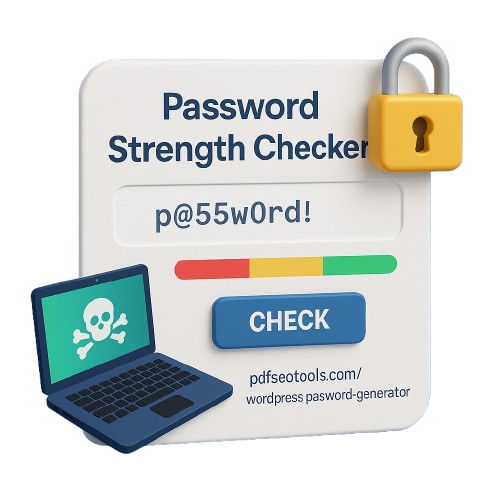
Password Strength Checker
🔐 Check Your Password Strength Instantly! Boost your online security with our fast and easy-to-use Password Strength Checker. 💪🔒 Perfect for staying safe online
Share on Social Media:
The Most Common Poor Password Practices🔓

Create Easy Passwords🔓

Reuse Passwords🌀

Sharing Passwords Insecurely📤
Writing watchwords Down, or Storing on Spreadsheets or on your Phone📝📱

Skip Adopting MFA❌

Letting Browsers Save Your Passwords💾
About This Password Checker Is it actually safe to use Password Checkers?
Is it actually safe to use word Checkers?🤔
still, also good – the quickest way to get addressed online is to be too trusting or assume websites are automatically safe,🧠⚠️ If you’re reading this section. It’s good to be conservative and it’s noway a good idea to enter your licit credentials into any website you are n't confident about.🛡️ The bones to watch especially are those who ask you to input your credentials.👀🛑


So, why is this Password Strength Meter safe?🧪🔐
- The watchwords you class noway leave your cybersurfer and we do n’t store them( You can dissociate your internet connection and also try it if you wish)🧍♂️🌐
- All the checking is done on the runner you’re on, not on our waiters🖥️🛠️
- Indeed if the word was transferred to us, we would n’t actually know who you were anyway – so could n’t match it up to any usernames or any websites you may visit🕵️♂️🚫
- We’re in the business of making people more secure online and the last thing we want to see is watchwords being transmitted across the internet insecurely.🚷🔒
How does My1Login’s Password Strength Checker work?
- The word strength calculator uses a variety of ways to check how strong a word is.🔢🛡️ It uses common word wordbooks, regular wordbooks, first name and last name wordbooks and others. It also performs negotiation attacks on these common words and names, replacing letters with figures and symbols – for illustration it’ll replace A’s with 4’s and@’s, E’s with 3’s, I’s with 1’s and!’s and numerous further. Negotiation is veritably typical by people who suppose they’re making watchwords stronger – hackers know this though so it’s one of the first effects playing software uses to crack a word 🎭🧑💻
- The word strength cadence checks for sequences of characters being used similar as “ 12345 ” or “ 67890 ”🔢
- It indeed checks for propinquity of characters on the keyboard similar as “ qwert ” or “ asdf ”.⌨️📉

Strong Passwords Tips and Tricks
Common mistakes and misconceptions🚫💡

- Replacing letters with digits and symbols. This fashion is well known to hackers so switching an “ E ” for a “ 3 ” or a “ 5 ” for a “$ ” does n’t make you much more secure🧙♂️🔓
- That meeting the minimal conditions for a word makes it strong. By moment’s norms, an 8- character word wo n’t make you veritably secure🧻🔐
- That it’s forfeiture to use the same word a lot as long as it’s strong – what if the website is addressed? Do you know how the website stores your word? What if they store it in plaintext?💥📉
Guilty🙋♂️🔓

- Weak practices – storing watchwords in the notes field on your phone, does it bus sync to the pall, iCloud or Dropbox🌥️📱
- Putting them in a spreadsheet, indeed word guarding a spreadsheet does n’t keep the information safe.
What makes a strong password?🏋️♂️🔐

A strong word is one that’s either not fluently guessed or not fluently brute forced. To make it not fluently guessed it ca n’t be a simple word, to make it not fluently cracked it needs to be long and complex.🔐🧬 Super computers can go through billions of attempts per second to guess a word. Try to make your watchwords a minimum of 14 characters.🎯🔢
Passphrase🗣️🔒

A passphrase is just a longer password – a sentence with spaces and punctuation 📜✨
It’s easier to remember, and waaaay harder to crack 🔐🧠
Each extra character doubles the time it takes to brute-force it. So length wins over funky symbols every time 🕰️🏆